ServicesGutters
Gutter Repair and Installation in Luther
Most gutter trouble starts with something you can't see from the yard: a rotted fascia board, a run pitched the wrong way, or a downspout dumping water at the foundation. We find the cause first, show you what we found, then recommend a repair or new gutters.
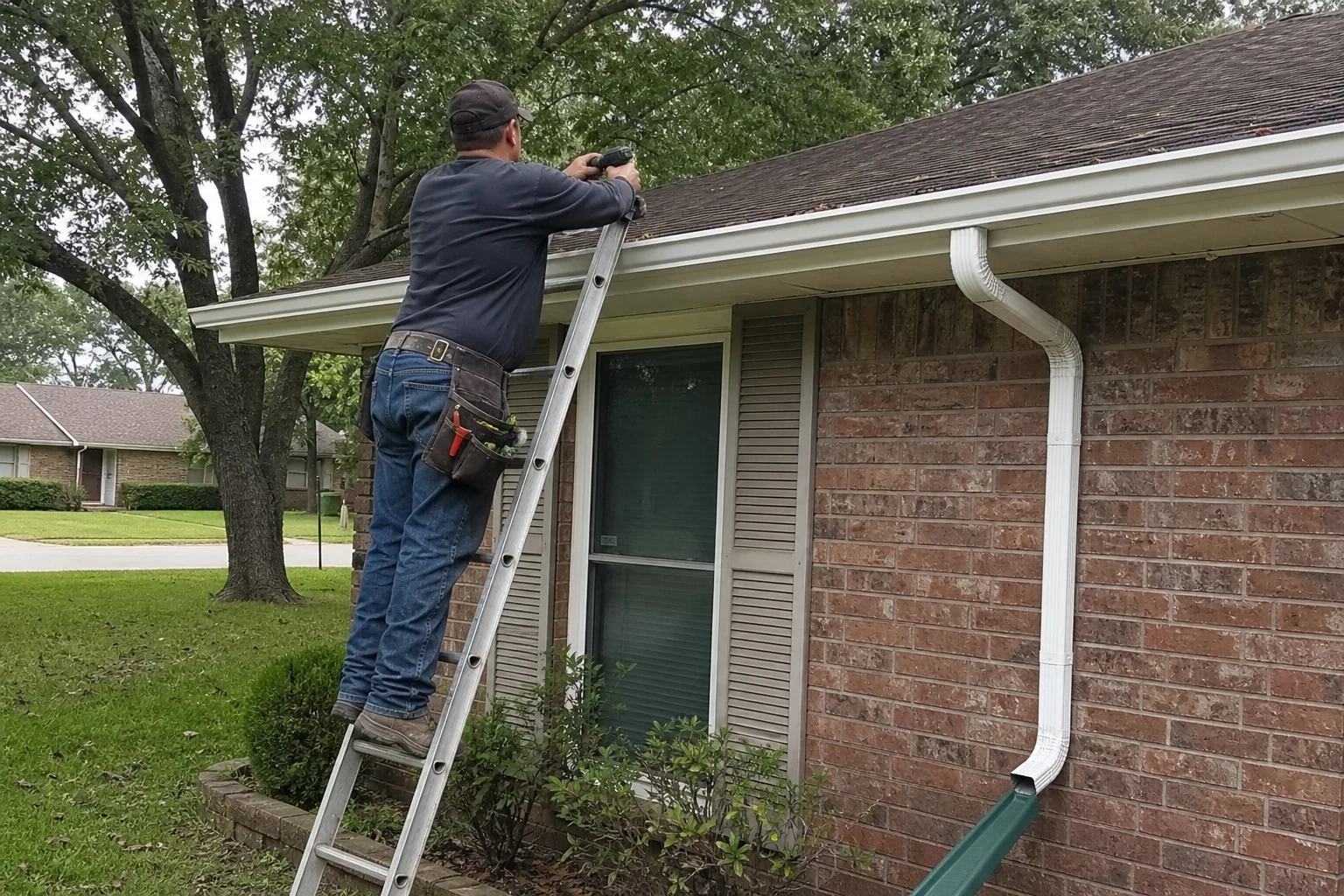
What Your Gutters Actually Do
A gutter system catches the water sheeting off your roof and moves it to a spot where it won't rot the fascia, stain the siding or saturate the soil along your foundation. When a run sags, a joint opens or a downspout clogs, that water ends up in the wrong place. Over a few seasons it softens the wood behind the gutter and loosens the ground under your slab or crawlspace.
We start every gutter job by checking the parts that decide whether new gutters will last: the fascia boards, the drip edge at the roof line, the slope of each run and how the downspouts discharge. If a few hangers and a resealed corner will fix it, we tell you that. If the fascia is soft or the system is undersized for your roof, you'll see it in our photos before you hear a price.
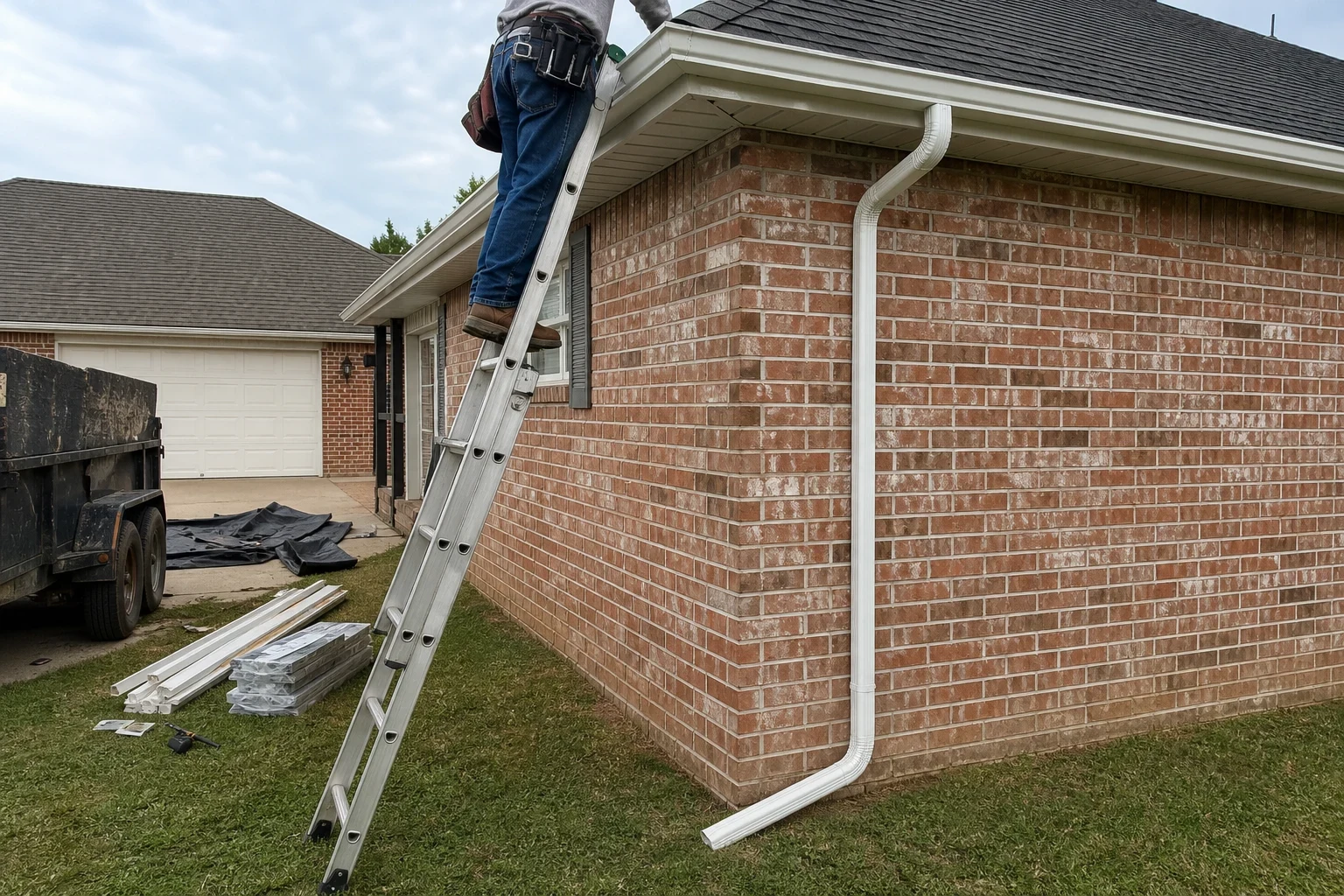
What Our Gutter Work Covers
- 01
Continuous aluminum gutters
We roll K-style gutters from aluminum coil right at your home, cut to the full length of each eave. Seams appear only where a run turns or stops, so there are very few spots where aging sealant can open up and drip.
- 02
Downspouts and discharge
We size and place downspouts for the roof area each one drains, then add extensions or elbows so water lands well away from your foundation.
- 03
Hangers and correct pitch
Gutters are fastened with hidden hangers screwed into the fascia, spaced closely enough to hold the weight of water and ice. Each run gets a steady slope toward its outlet so water doesn't sit and pool.
- 04
Fascia and drip edge checks
Before anything is hung, we check the boards it hangs on. Soft or split fascia gets replaced, and we make sure drip edge directs roof runoff into the gutter instead of behind it.
- 05
Gutter repair
Leaking miters, failed end caps, loose spikes and sagging sections can often be fixed without replacing the whole system.
- 06
Gutter guards where they fit
If heavy leaf drop keeps clogging your gutters, we'll explain which guard styles suit your trees and roof, and where they would just add cost.
Questions about Gutters?
Call(405) 407-1742When Your Gutters Need a Look
Overflow at the corners
When water pours over inside corners in a heavy rain, the cause is usually a blockage, an undersized downspout or a run sloped away from its outlet.
Gutters separating from the fascia
A gap behind the gutter typically means loose spikes or decaying wood. The longer it stays that way, the more water the board soaks up.
Dark streaks or flaking paint on the fascia
Stains on the fascia show water is running behind the gutter, which is where rot begins.
Leaks at seams and end caps
Years of summer heat and winter freezes make old sealant shrink and crack. A steady drip at a joint is an early, inexpensive repair when you catch it soon.
Eroded soil or puddles by the foundation
Grooves cut into the mulch or water standing beside your walls mean the downspouts aren't moving water far enough away.
Hail dents
Hail can dent gutters and downspouts, slowing the flow and breaking the seal at joints. If the gutters took hits, the roof above likely did too, and our storm damage repair service can check it.
How a Gutter Job Runs
- 1
Inspect from the ladder and the roof edge
We check every run for slope, fasteners, joints and debris, test the downspouts, and probe the fascia for soft spots. We also look at the shingle edge and drip edge, since roof runoff and gutters work as one system.
- 2
Show you the findings
You get photos of what we saw and a plain explanation of the cause. Then we give you our recommendation, repair or replace, with a written estimate broken out by line.
- 3
Prep and remove
On install day we take down the old gutters, replace any damaged fascia, and confirm the drip edge is in place before anything new goes up.
- 4
Form, hang and pitch
We roll each run in one continuous length from our forming machine, set the slope with a string line, fasten with hidden hangers and seal the corners and end caps.
- 5
Flow check and cleanup
Before we pack up, we pour water into the high end of every run and watch it reach the downspout without pooling. Then the old metal goes on our truck, and we sweep your yard for screws and trim scraps.
What Moves the Cost of Gutters
Gutters are priced mostly by length and complexity, but the condition of the wood behind them can change the number more than anything else. That's why we inspect first and put every line in writing. You'll know what's for the gutters themselves and what's for repairs underneath.
- Linear footage and height
- Longer runs take more material, and a two-story home needs taller ladders and more setup time than a single-story ranch.
- Corners and downspouts
- Each miter, outlet and downspout adds parts and labor. A roof with many valleys and hips needs more of them.
- Fascia condition
- Rotten fascia has to be replaced before new gutters can be fastened securely. We won't know the extent until we probe the boards.
- Gutter size and metal gauge
- Six-inch gutters and heavier-gauge aluminum cost more than five-inch, but they handle steep or large roof planes better.
- Guards and removal
- Gutter guards and disposal of an old system are separate lines, so you can see their cost on their own.
Common Questions About Gutters
Should my gutters be five-inch or six-inch?
That depends on how much roof drains into each run and how steep it is. Many single-story homes do fine with five-inch gutters. Big or steep roof planes, particularly those that feed a valley, often need six-inch gutters and larger downspouts to handle heavy spring storms.
Is repair possible, or do my gutters need to be replaced?
Loose hangers, a leaky corner or one dented section can usually be fixed. When many joints are failing, most runs have the wrong pitch, or there's rot behind the system, replacing it is the better value. We'll show you photos and explain where yours stands.
Is it smart to do gutters and the roof together?
Often, yes, since new drip edge is installed with a roof replacement and the gutters hang just beneath it. Doing both at once means the gutters only come down one time. If yours are in good condition, we can put them back up instead.
Do gutter guards pay off?
They help most under trees that shed lots of leaves, twigs or seed pods. Guards still need cleaning now and then, and some types have trouble with fine debris such as pine needles. We'll tell you straight whether guards suit your yard or whether routine cleaning costs less.
Does insurance pay for gutters damaged by hail?
In some cases, as part of a roof or storm claim. We can photograph the dents and damage and explain how claims usually work. Whether it's covered is up to your adjuster.

Find Out What Your Gutters Need
We'll check the runs, the downspouts and the boards behind them, then explain what we found before recommending anything.